architecture of absence.
- Lottie Anne Murray

- Sep 21, 2025
- 6 min read
[findings and speculations from thesis research.]

Absence defines as much of the Outer Hebrides as presence. To walk the islands is to encounter landscapes marked not just by what stands, but by what has gone: the blackhouse ruin open to the sky, the shuttered window of an abandoned croft, the loss of a native language, the empty desks of a school. These are not simply voids; they are architectures of absence, structures that bear testimony to histories of displacement, decline, and endurance.
This post looks into social factors in the Outer Hebrides and uses absence as a lens of analysis. It asks how absence - of people, of language, of continuity - shapes the lived landscape, and how we might learn to read the traces it leaves behind. By doing so, it connects demographic change, cultural erosion, and architectural form, revealing how absence itself becomes a presence in the islands.
What is striking in the Hebrides is the scarcity of first-hand accounts from those who lived through displacement, clearance, and hardship. Much of this history is not written in words but inscribed in place. The ruins that scatter the landscape, act as a kind of testimony in stone and timber. In the absence of written voices, it is the built environment itself that carries the lived experience forward, encoding memory into the very land.
[ruins as memory.]
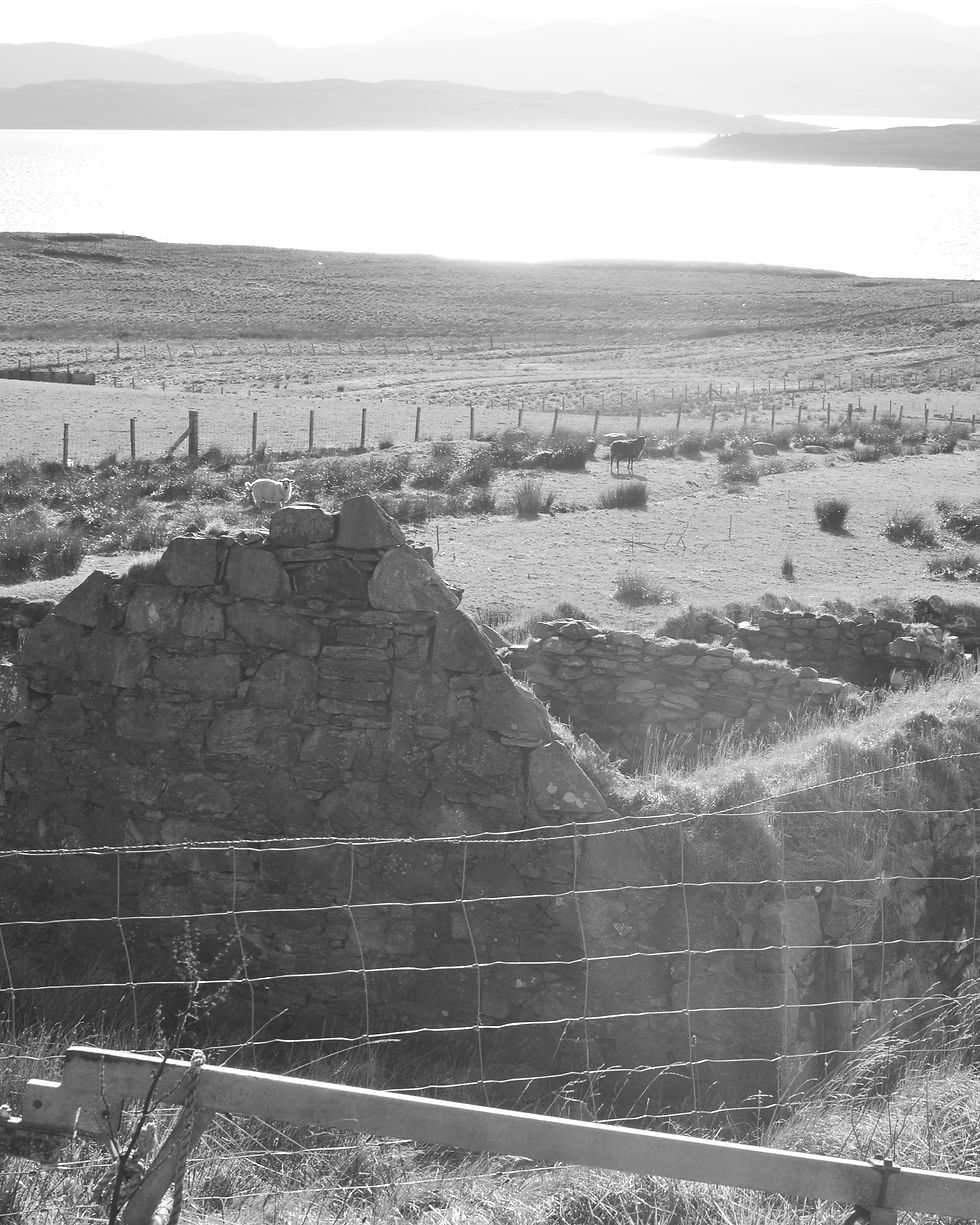
The ruin of a blackhouse is more than a relic of domestic life. It is an archive of loss. Each collapsed roof and moss-filled wall marks the shift from cyclical building traditions to imported modernity, but also the deeper fracture of cultural continuity. These ruins invite projection: memory, imagination, grief. They tell stories of belonging interrupted, of lives uprooted, of languages spoken and then silenced.
In the Hebrides, absence becomes legible in the land itself. Vacant villages embody collective emigration, their absence echoing louder than the houses that remain. They remind us that modern Scotland’s rural “emptiness” was not natural, but manufactured: the product of clearance, improvement, and economic restructuring. These are not just historical traces of the Clearances but ongoing presences of absence: reminders that land use was once wrested from its people.

[demographic absences.]
Absence is also demographic. Since the beginning of the twentieth century, the population of the Outer Hebrides has almost halved. Entire generations were described to be “bred for emigration,” as Somhairle MacGill-Eain [Sorley MacLean] once wrote, and the pattern endures. Today, young islanders often leave for education or work, rarely to return. What remains is an aging population, communities where school rolls shrink even as care needs rise. The architecture of absence is therefore not only ruin, but the missing neighbour, the boarded-up shop, the village school repurposed as a community centre because there are too few children left to fill it. Current forecasts suggest the Western Isles region will have the steepest regional decline in Scotland by 2039. Absence is not only a memory; it is a projection.
The absence of youth is particularly felt in housing. While second homes rise and social housing estates proliferate, many crofts remain empty or under-inhabited, severing ties between land and family continuity. Architecture here traces the contradiction of scarcity amidst vacancy: houses stand empty while demand grows, a paradox born of outmigration and external ownership.
[absence of language.]
Absence resonates, too, in language. Gaelic, once the living tongue of nearly every household in the Hebrides, has receded to less than half the population. Where place-names, house-names, and everyday speech once embedded the land in language, silence now often replaces it. As John Murray notes, “reading the landscape through the lens of Gaelic” allows for a deeper understanding of its cultural depth. In this sense, architecture holds absence as much as presence: a blackhouse ruin called by its Gaelic name still retains meaning, but a new house named only in English marks a cultural rupture. The erosion of language is architectural because it changes how places are seen, named, and inhabited.
This linguistic absence is not merely symbolic. It reflects a broader thinning of cultural life, where songs, stories, and oral traditions fade as speakers dwindle. In the ruins of homes, we find the absence of voices as acutely as the absence of roofs.
“He who loses his language loses his world.”
IAIN CRICHTON SMITH, 1986.
Writers like Iain Crichton Smith have long expressed how deeply language defines belonging for a native Gael. For him, the erosion of Gaelic was not just the loss of words, but the loss of a worldview, a way of seeing that English could never fully translate. He has referred to the loss of language within a native gael is to be “colonised completely at the centre of the spirit” (Iain Crichton Smith, 1977). Certain terms like dùthchas, carrying layers of meaning around kinship, inheritance, belonging, and moral responsibility to land, are particularly poignant. They resist direct translation, embodying concepts that stretch far beyond their English equivalents. It was for this reason I named my own design project Dùthchas: as an act of recognition, and as a reminder of what is at stake when language fades.
In many ways, I feel myself to represent this particular absence. My parents speak Gaelic, yet I find myself only at a beginner level, a faltering inheritor of a tradition I was not fully immersed in. It is a kind of loss written into my own voice, a reminder of the cultural distance that can open even across a single generation. Crichton Smith might have found disappointment here, yet I hope this acknowledgement also points to the possibility of recovery. To speak even a little is to resist erasure, to begin rebuilding presence where absence has crept in. After all Is fheàrr Gàidhlig bhriste na Gàidhlig sa chiste [broken gaelic is better than dead gaelic].
[the politics of extraction.]
Absence also stems from a politics of extraction. Land cleared for sheep, kelp harvested for distant markets, populations drained by emigration, all have left absences inscribed in the landscape. Today, these patterns persist in new forms. Wind energy schemes dot the moors, their profits flowing elsewhere. Second homes stand empty for much of the year, producing villages that appear full but are lived as hollow. In each case, the islands are treated less as communities to sustain than resources to extract, leaving cultural and demographic absences in their wake

“I am depressed,
seeing now so many rafters bared,
missing the fire with its welcoming flame;
the moon sheds light through the ribs
of this Highland-Lowland house tonight.”
RUAIRIDH MACTHÒMAIS.
[DERICK THOMSON]
EXCERPT FROM THE HIGHLANDS
[absence as presence.]
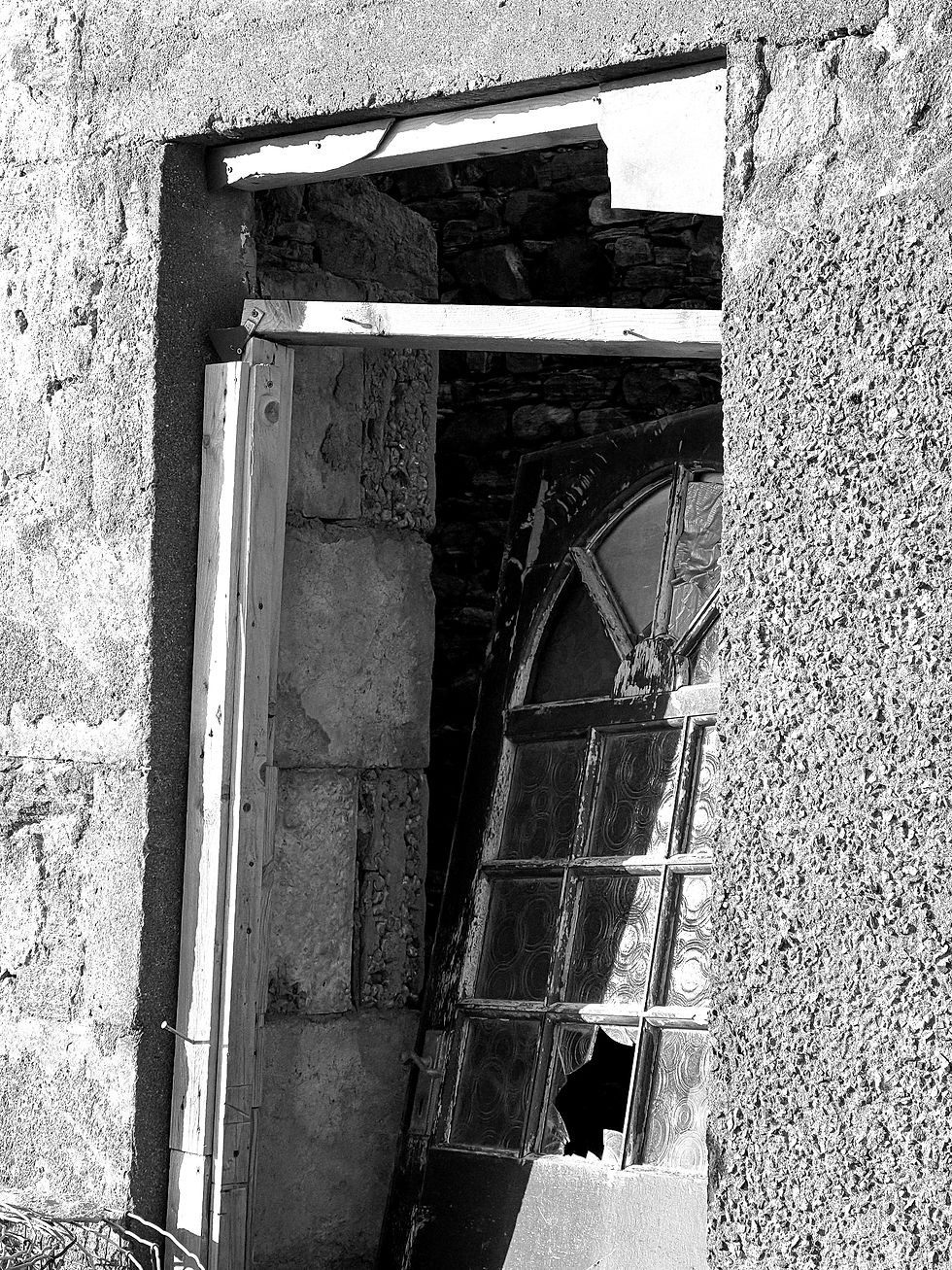
And yet, absence here is never empty. The ruins resist total erasure; language persists in fragments; communities adapt to new pressures. Schools closed through depopulation are transformed into community centres, spaces that reclaim social presence where educational presence has waned. Blackhouses, even as ruins, still structure memory and belonging, resisting commodification precisely because they are incomplete.
Absence itself becomes a form of presence in the Hebrides. It sharpens awareness of what was, and of what is at risk of disappearing further. It reminds us that the margins of Scotland are not peripheral but central to understanding its history: a history of displacement, resilience, and survival against erasure.
[reading absence.]
To speak of an “architecture of absence” is not to romanticise decay but to take absence seriously as a cultural force. The Hebrides offer an unsoftened clarity: absence of people, of language, of opportunities, appears here with an intensity magnified by isolation. Island life, by its very nature, distils and amplifies truths. What appears elsewhere in rural Scotland in slightly more muted tones; depopulation, housing precarity, cultural erosion, becomes here an exposed rawness.
This makes the Hebrides a microcosm of wider rural realities, but also an amplifier. The architecture of absence reveals how loss is structured, not incidental; how absence is produced, not natural; and how even within absence, there is a persistence that resists total forgetting
This post continues my series on the edge - an analysis of cultural landscapes of the Outer Hebrides. Where the first post traced the unique identity of island living and a region often overlooked, this one turns to absence as a common thread between themes, analysing it as both wound and witness. Future posts will follow threads of materiality, language, and kinship, weaving together a picture of life at the edge; fragile yet enduring, diminished but still present.

Comments